

Locating Pastors in Institutions
The Limits of the Seminary-Centric Model
The expectation for where we find pastors to labor in the work of ministry commonly starts with those who are enrolled in (or graduates of) a pastoral training program at Bible colleges and seminaries. And this indeed is a great place to start, as many have made an early life commitment to pastoral and shepherding work and are pursuing God’s convictions for their lives.
The further we dig under the surface, however, the more shortcomings we uncover with this institution-centric strategy for filling local churches with the leaders she needs:
The need for leaders in the global church is greater than the number of Bible college and seminary graduates pursuing these pastoral roles.
The church is a family of families. One dad in a family does not raise a few hundred children on his own. We need a multitude of leaders over God’s flock—both the kind that can stabilize a local congregation and the kind who can press the gospel forward to unreached areas and peoples. Bible colleges and seminaries are typically not cheap, and they are also not available or accessible throughout all parts of the world. If these types of institutions are our only source for pastoral leadership, the global church will be severely limited by the overall small number of graduates pursuing pastoral work.
Not only are these institutions difficult to scale across the globe, but even where they do exist, the overall number of graduates pursuing pastoral work is on sharp decline. As of 2013, according to the Association of Theological Schools, only 41% of Master of Divinity graduates expect to pursue full-time church ministry, down from 90% or more a few decades prior. And even of those 41%, there are other issues…
Bible college and seminary graduates are typically enrolled and graduated outside the context of a local church.
The institutions of Bible colleges and seminaries are relatively modern in existence, having their initial roots formed at the time of the Reformation in the sixteenth century. In North America, Harvard College was founded in 1636 with a goal of training clergy, but the first formal seminary in America didn’t come until 1808 (Andover Theological Seminary). Understanding “this isn’t always how it was done” when it comes to recognizing and calling pastoral leadership is important. The process of identifying men for ministry has its roots in the lifeblood of the local church itself.
-
In Acts 6:1-7, when a ministry need surfaced in the early church, “seven men of good repute, full of the Spirit and wisdom” (vs. 3) were chosen from among the congregation to serve. The process involved affirmation from the apostles and the people—it was done in the context of the local church.
-
In Acts 13:1-4, we see a picture of the Holy Spirit calling Barnabas and Paul to mobile missionary work in the context of their local church leadership team.
-
In Acts 16:1-5, a young leader named Timothy was selected directly by Paul to join the work of his ministry.
In each of these cases, new leaders were chosen by existing leaders (or by God directly). Today, the institution has become the primary gatekeeper both for who is qualified to enter a pastoral training process and for who is ready to enter pastoral ministry—and this includes Bible colleges and seminaries as well as the highly influential accrediting agencies behind them. While Bible colleges and seminaries can be very valuable and effective in training pastors, it should be recognized that this disconnect of leadership selection and leadership training from the lifeblood of the church and its leaders breaks from the mold of Scripture and much of church history.
It is common for Bible college and seminary graduates to be young, immature, and inexperienced
God has used young people all through history for great things: Joseph, Joshua, Samuel, David, Josiah, and Timothy to name a few from Scripture, and Calvin, Whitefield, Edwards, and many more since. The young and zealous need to be celebrated. Paul even directly defends his gifted, youthful protégé Timothy: “Let no one despise you for your youth, but set the believers an example in speech, in conduct, in love, in faith, in purity.” (1 Timothy 4:12).
At the same time, we need to recognize the day in which we live. Most who enroll in Bible colleges and seminaries are coming directly out of high school. At the risk of overgeneralizing today’s youth: they often lack life experience. Ministry experience. Wisdom. And further, on average, each new generation seems to deteriorate its standards for maturity and competency more so than the last. Of course, there are wonderful exceptions. But generally, are these young people ready for shepherding God’s flock after a few years of classes? Some are. But most are not.
A track that becomes full-time ministry or… bust?
For a young person who has pursued pastoral and ministry training at a Bible college or seminary, they are commonly left with a ‘generic’ Bible degree that has very limited ‘currency’ outside of Christian churches or organizations. Some Bible colleges mitigate this by offering “dual degree” programs, which can help to give broader options upon graduation. But most students who are truly pursuing pastoral work forego that option and have limited job choices outside of Christian institutions upon graduation. Put simply, many enter school with an expectation of being paid by a church upon exiting.
There are a limited number of openly available, paid, full-time (vocational) pastorate positions available in the church (especially globally). Many young graduates do not have the appropriate experience for the type of role they desire most within a church (being the primary leader/pastor of a church body), so as a result they commonly settle for other kinds of paid roles they qualify for: youth ministry, worship leader, adjunct professor, or accepting limited pay as a traditional bivocational pastor. These roles are often seen as ‘stepping-stone’ roles toward their eventual goal of vocational pastoring. Other graduates who once pursued pastorates end up pivoting and heading an entirely different direction—taking a lower-skilled (and often lower pay) industry job or pursuing additional education for a different line of work entirely. For some, this career realignment is a painful process that begins later in life—perhaps only after years of working in various ministry positions and trying to achieve that ‘senior pastor’ goal do they recognize this is not their true calling.
The chart below maps out the progression of a ‘traditional’ pastoral path:
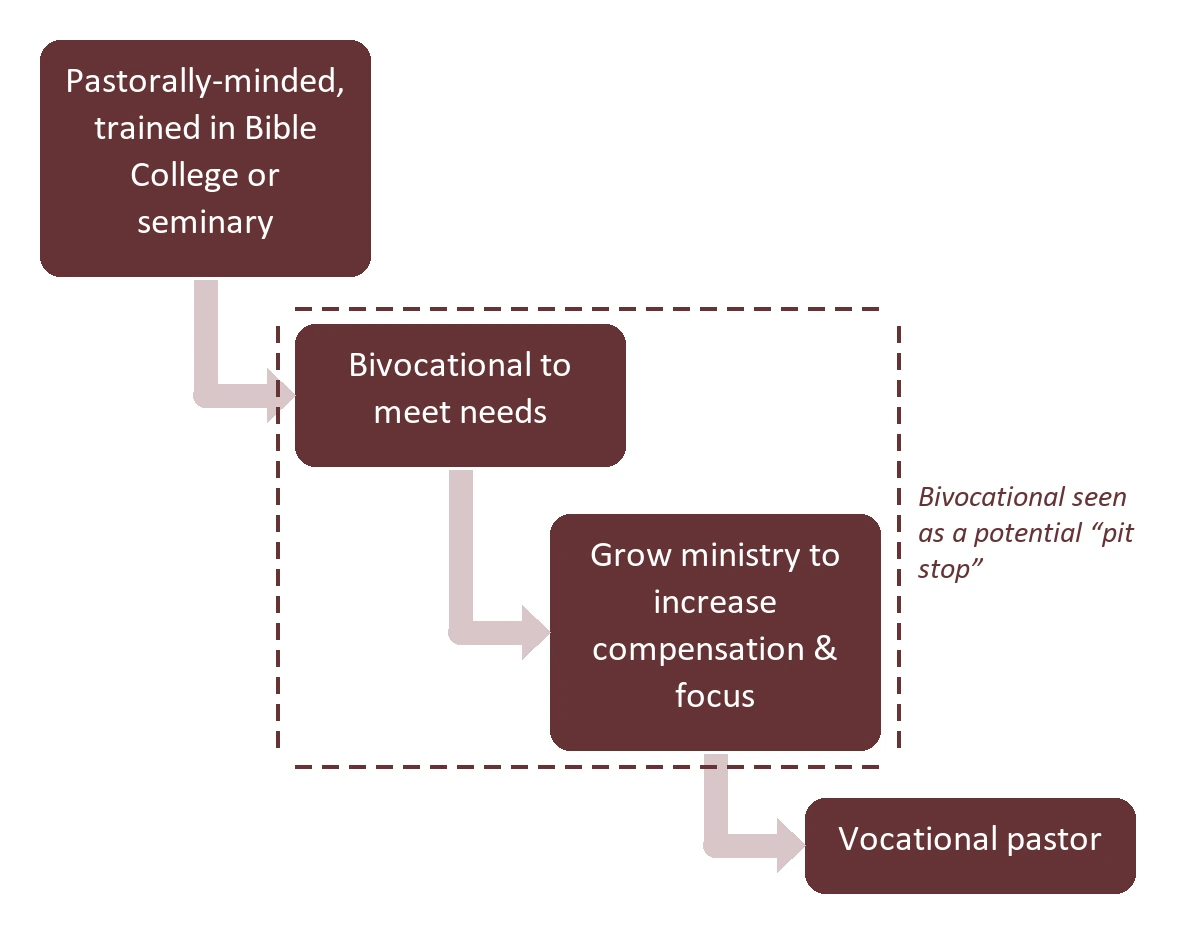
In terms of a scalable strategy for developing leaders to empower the global church, institutions having a central role seems self-defeating: many of the graduates and their families end up in the global church’s “support system”. They are either directly compensated by local churches growing their staff or perhaps as instructors in the same kind of institutions in which they started. And as those churches and institutions grow their staff, they must be fed with more churched people giving toward pastors or more students paying tuition for professors—feeding the cycle.
Isn’t there a better way?