Locating Pastors in the Church
Raising Shepherds from Within the Congregation
When we flip the institution-centric strategy to a strategy that brings the local church front and center, we begin to see that identifying, training, and empowering “vocationed pastors” is a key strategy to the spread of the gospel. This strategy is scalable enough where each pastor has the foundation of a sustainable vocation in their culture. This strategy is organic enough to let the Holy Spirit work through the church to identify and empower leaders within the church. And once they are identified, it means having a leadership training process that is robust enough to prepare them for pastoral ministry—a training process which simultaneously involves learning and doing “in-service” ministry while also continuing a full-time job.
The implications here mean a significant mindset shift for many churches, where “lay” people are not only treated solely as ‘valuable volunteers’—committee members, Sunday school teachers, choir singers, or administrators of the church and its property, budget, and systems. It means shifting from a centralized model where all shepherding care, counseling, and teaching flows through the paid staff, into a model where pastors/elders are multiplied from within the church and given authority along with responsibility to care for their people.
One inevitable and challenging aspect that surfaces while trying to build a team of vocationed pastors is how to motivate gifted people with potential to take the next step to actually move forward and take it. What if no one signs up for the first leadership training class? Much here depends on the church situation. Pray for men to come forward. Preach boldly. Start a small training cohort with just a few people. Look for signs of life anywhere in your congregation and seek to tap into it. Often when the first few come and demonstrable progress and exciting camaraderie and growth are seen, more will follow.
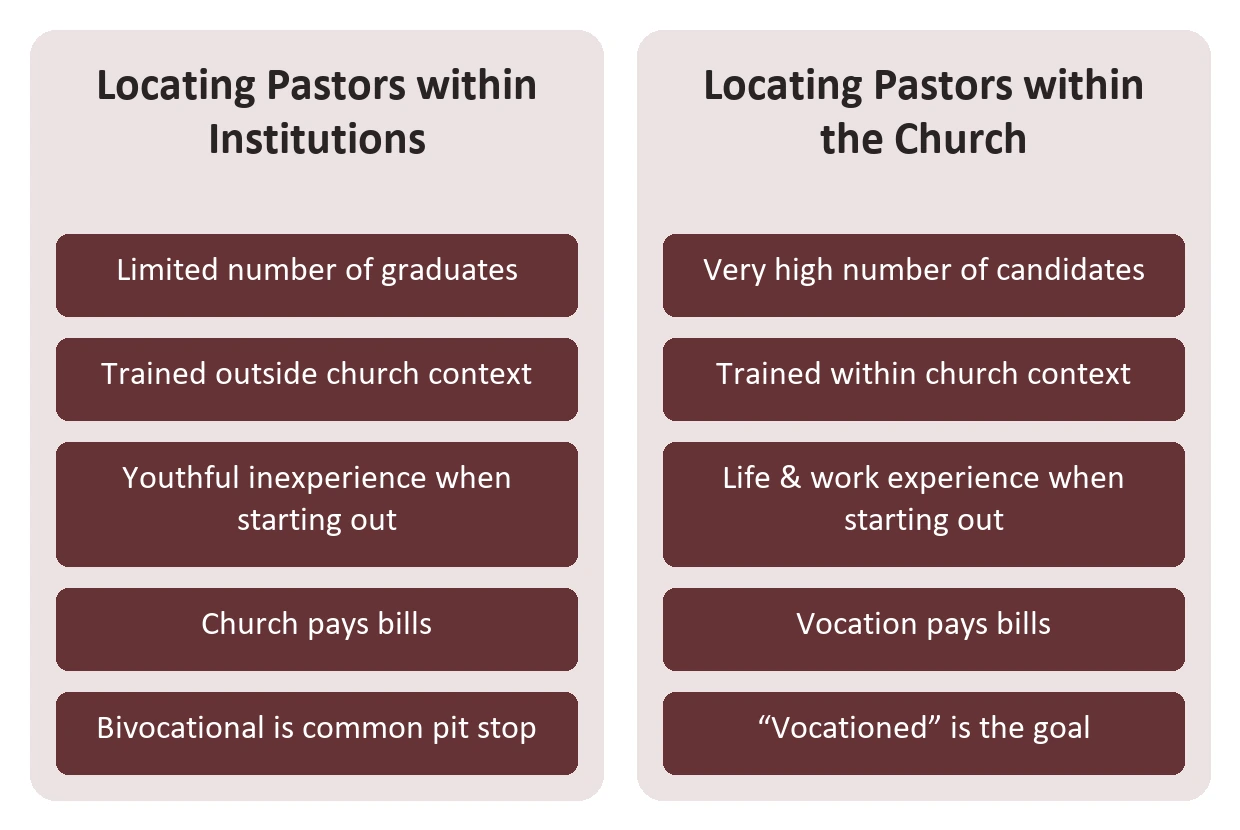
In any case, locating pastors within the church, as challenging as it can be, addresses many of the shortcomings of the institutional model:
A very large pool of potential leaders exists within the local church.
The next church planter in your congregation could be a faithful member of the worship team. The sound technician might be the perfect person to shepherd a new small gathering and care for them faithfully as life issues arise. The dedicated nursery worker and prayer warrior might just be waiting for their leadership potential to be tapped to break out of their shell. Many in these roles whom God has gifted and prepared for leadership are deferring to the paid staff for the bulk of the shepherding work. While there are exceptions, churches in general have become a bit too comfortable with this relationship: the staff are all too happy to keep the visibility and notoriety their centralized roles bring, and many in the congregation with potential to do much more in God’s church are all too comfortable continuing to allow the staff to be the ones to roll up their sleeves and get messy.
Once a church shifts its thinking to the development of vocationed pastors and empowers them to lead God’s family, the potential pool of candidates is no longer limited by the church budget. The field is wide open. Many churches today have ‘lay leaders’ ready to be activated for service; they just need to intentionally pursue and invest in them.
Training leaders in the context of the local church fits the needs of the church and fits the life situation of the leaders.
When the church is in the driver’s seat for the theological education of a developing leader (rather than the institution), it enables the learning process in character, knowledge, and skill to be interwoven with the life of the church. Rather than a professor or peer assessing character (who has likely known a student for only a short time), it can be someone in the church who may have known the student for decades. Rather than in-class discussion focusing on hypotheticals and made-up church situations, the intersection of learning new ideas along with their practical outworking can be powerfully combined with class discussion that incorporates their current local church and its people, neighborhoods, opportunities, and challenges. And rather than students developing practical ministry skill through simulated classroom environments, or even through a few smaller responsibilities at a church located near their seminary, they can be given real opportunities to develop skills within their own local church in a way that both maximizes their gifts and meets the ministry needs of the church. This symbiotic relationship also helps existing pastors and leaders better assess giftedness and provide meaningful feedback to those in training.
There are a multitude of practical benefits to training leaders in the context of a local church as well. It’s cost effective (typically free or close to it), making the barrier of entry small. In addition, the experience can be highly customized to meet the needs of all involved—the training schedule, location, cadence, class selection, and duration can all be tailored to fit the needs of the church, trainer, and trainees. Lastly, like Jethro’s advice to Moses in Exodus 18, it distributes the burden of shepherding care for a large group of people among many rather than few.
Identifying and training leaders in the context of the local church surfaces more mature, stable leadership candidates.
It’s not true in every case, but for the most part, those identified as ready to be trained as vocationed pastors bring some pretty great qualities: maturity, life experience, a steady vocation where they are respected, are typically in their late twenties or early thirties (at the youngest), many have established marriages and family roots, and, maybe most importantly, they bring an eager desire to learn and grow and be used in the church. Many are already leaders in multiple other capacities inside and outside the church and bring a proven track record of consistency, faithfulness, and disciplined living.
Committing to a pastoral, shepherding leadership role in the church is no small thing. This type of work cannot be neatly contained to monthly committee meetings or periodic breakfast meetups. Another benefit of a church-based training model is the ability to put an ask on the table for a specific time commitment to a potential leader—including both for training and for ministry—and to be able to discern their response as a signal of their readiness to serve.
A vocationed pastor has a sustainable income that feeds resources into the church rather than drawing them away.
Most all skilled and well-compensated jobs in the West require specific degrees from specific types of universities. Whether you want to be an accountant, nurse, engineer, lawyer, doctor, scientist, teacher, business owner, architect, banker, or something else, specialized training is almost always required. And whether it’s one of these jobs or one of many others, what better time to pursue a sustainable “tent-making” vocation than early in life? Upon graduation you then enter the working world, invest into a solid church community, and focus on getting established in your faith and pursuing maturity.
Putting these last two sections together, below is a high-level comparison summary: