A Journey to Build Vocationed Pastors
An Example Training Pathway
There is a way forward. And that way forward looks like activating the untrained, untapped saints to fulfill their God-given calling. It should again be reiterated that the global church does indeed need pastors giving themselves (bivocationally and vocationally) to faithfully ministering the word of God to their people, many of them compensated by churches to enable their full attention and devotion. The health of the church depends on it. And a few other types of roles in some churches and cultures will need to be paid full-time as well for the church to sustain itself. However, beyond this, when it comes to multiplying pastoral leadership, the fundamental model arguably needs to change.
It starts with a baseline recognition that God could decide to use any Christian to shepherd his flock. Through Jesus Christ’s priestly office, each individual regenerate believer is united with him as “a chosen race, a royal priesthood, a holy nation, a people for his own possession”, enabling them to “proclaim the excellencies of him who called you out of darkness into his marvelous light” (1 Peter 2:9). From among any true believer God may have given us one gifted as an “apostle, prophet, evangelist, shepherd, or teacher” (Ephesians 4:11). And not only among those who decided to pursue Bible college or seminary.
For the pastoral leadership of the global church to scale, we need to break the self-imposed evangelical glass leadership ceiling as we inspire and train vocationed pastors to help shepherd the flock, mature disciples, and multiply churches. Put simply, let’s empower the men with ‘regular’ jobs, those who did not graduate from Bible college and seminary, to be trained to lead as shepherds and pastors alongside the paid pastor(s). This road is certainly not an easy road, and admittedly is not a well-paved road, but it is one down which we must travel.
But how do we get there?
While impossible to nuance every context in this primer, some key principles can be provided in sketch form. The five principles below are geared toward an existing church and how it could get going on this journey, whether it is currently staffed with a single bivocational pastor or multiple vocational pastors:
First, build (or revisit) the philosophy of ministry foundations of your church. A philosophy of ministry is not a statement of faith or doctrine, but rather a written strategy for how your church goes about fulfilling its mission. Start these conversations with the core leadership team, going through the Book of Acts and its implications as a team. Consider retooling leadership meetings to shift from an administrative focus to a strategy and shepherding focus. Preach Acts to the church and highlight the principles of ministry philosophy your team has aligned on. Assess how well the existing ministries and programs are enabling your church to participate in the Great Commission. Revisit the job descriptions of existing pastors (including yourself!)—there may need to be a significant shift in thinking—from having the bulk of ministry flow through the staff to shifting to a decentralized model over time that focuses the paid staff’s time on equipping, empowering, and training vocationed pastors to shepherd. Create a one-year and five-year vision. Many things can be on the table while revisiting the philosophy of ministry of your church—it is important to balance not going too fast (bring the people along!), but also not stagnating due to people’s fear of the unknown. Read Howard Snyder’s book Signs of the Spirit: How God Reshapes the Church, where he presents ten highly effective strategies for church transformation and renewal to help with this process.
Second, establish (or renew) small, church-like gatherings (small groups, community groups, house churches) in your church. For many churches, these will be a natural outcome from the first step. We need to be in relationship and authentic community with one another as God’s church. In smaller churches these small gatherings sometimes happen more organically (however they still may need to be retooled), but in larger churches they need to be more intentional. Small gatherings should facilitate every member of the congregation being known and cared for, as well as provide a place for new leaders in training to begin to take on real shepherding care responsibilities. These structures can (should?) become the lifeblood of the church, where mature disciples are formed, where leaders serve and are apprenticed, and where the community takes a missional posture toward the lost. Find or develop a catechetical curriculum for establishing believers in the faith (examples would be the Narrative Journey series, the First Principles series, etc.), and use these groups to take the church through an establishing and maturation process.
Third, develop a robust leadership training process that grows upcoming leaders in character, knowledge, and skill. Here is where the rubber meets the road. Many churches have parts and pieces of the first two areas, but what about the training of new leaders? What if God moved in miraculous ways and fifty new believers were saved and needed to be matured in the faith? We need leaders to support growth in God’s church, and we will often discover untapped leadership potential in our churches. Perhaps even inside of your small gatherings, perhaps on the worship team, perhaps in the men’s ministry—you’ll find those showing willingness and capacity to serve, spiritual sensitivity, passion for God’s word, desire to grow further, and natural mentoring and shepherding skill.
How can we multiply our small gatherings without more mature leaders to lead them? We need a training process inside our local church into which we can invite these disciples, one that can harness their gifts, expand their (typically self-imposed) limited expectations for leadership potential, and empower them to shepherd God’s flock. Seminary may have a role here at times, but ideally, this education would be fully church based and church integrated: a collaborative cohort led by a pastor or elder in the church that can meet regularly (typically weekly) and address all three aspects of character, knowledge, and skill. You could develop your own curriculum, assemble a curriculum using books or free training resources made available to churches, or incorporate seminary education here—on your church’s terms (integrated into the ministry life of the church). Some institutions such as the Antioch School offer pastoral training experiences intended to be run inside a church, but other online seminaries or web-based classes such as biblicaltraining.org could be incorporated as well.
This training, whatever form it takes, should grow them in character—involving regular self-assessment, assessment from others, established accountability relationships, and even written plans for character growth along with written reflection. This training should grow them in knowledge—robust theological training ideally with a mix of both systematic and biblical theology, taking them through all areas and genres of Scripture. The main areas of development should include doctrine/theology, mission, biblical interpretation, shepherding/counseling, habits, leadership, and even preaching. This training should also grow them in skill—a practical outworking of their learning to embed the principles deep. Being a church-based process, the skill development flows naturally into meeting the ministry needs of the church, which leads directly to the next step on the journey.
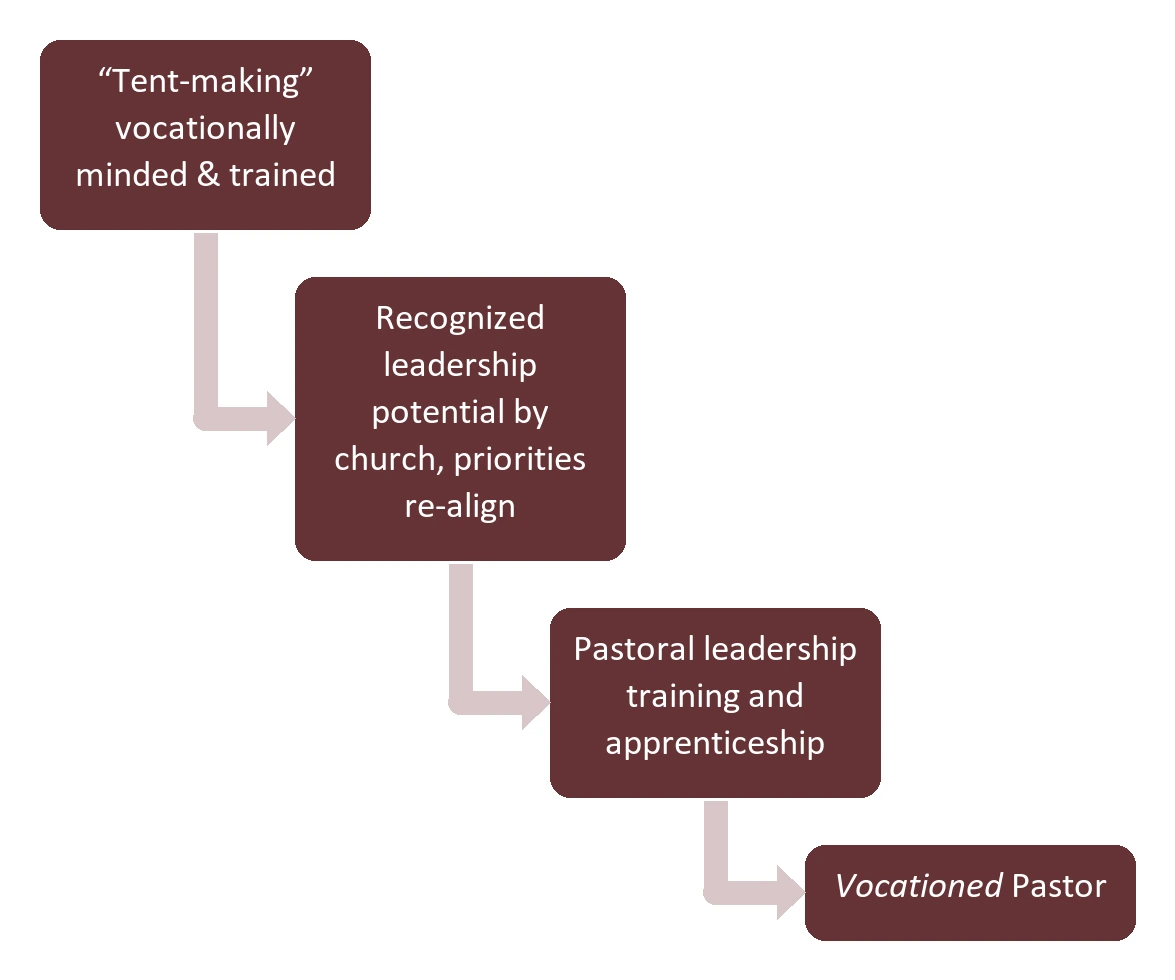
Fourth, empower leaders in training with real shepherding responsibility. This step is crucial. The intent is not simply to develop bloggers and thinkers, growing their head knowledge in order to facilitate wonderful theological conversations, but rather to develop shepherds in the church—practitioners who are able to balance their “tent-making” vocation with the care of both their family and God’s family—integrating each sphere of life together. In practice, this means giving shepherding care responsibility in your small gatherings for that portion of the flock. It could start as small as a single mentoring relationship, caring for someone younger (Titus 2). But they do need to be given real responsibility in this area to begin to grow as a leader. Like a student teacher or resident doctor, a leader with real shepherding responsibility is being given valuable “in service” ministry training.
Fifth, guide young believers interested in full-time ministry towards developing a tent-making vocation first. For some particularly called young people, the answer still might be attending Bible college and seminary directly out of high school. But for many—arguably for most—arming them first with a “tent-making” vocation—work that can sustain them and their family that does not draw on the resources of the global church—will pay lifelong dividends. This “steering toward the marketplace” should not, however, be at the expense of a missional and pastoral mindset. We should still seek to incorporate these youths into leadership training processes as early as possible; the difference will be the level of responsibility we give them—it should be proportional to their age, maturity level, and life situation.
The chart below presents a fundamentally different primary model, which is to focus on a sustainable income-earning vocation early in life while intimately involved in the life of a local church that can empower you for leadership: